
- Amazon average CVR is 8–20% depending on category — roughly 5–10× higher than off-Amazon ecommerce, driven by purchase-intent concentration.
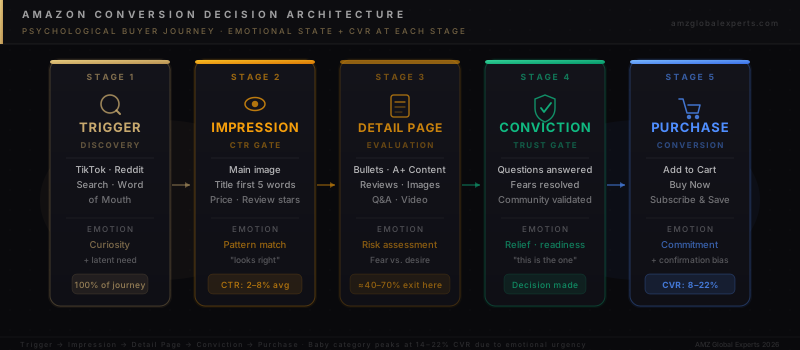
- The baby and children’s category consistently outperforms benchmarks at 14–22% CVR due to emotional urgency, prior community validation, and identity investment in the purchase.
- Listings using customer-language alignment — phrases extracted from review n‑grams and matched to bullet copy — show directional CVR lifts of +18–32% in controlled operator tests.
- The primary CVR killer is not keyword density or image quality — it is fear left unresolved. The listing fails when it answers features instead of the fear the buyer arrived with.
- AI search engines (Google AI Overviews, Perplexity, ChatGPT) are increasingly indexing listing content and review sentiment — making psychological alignment a GEO signal, not just a CRO lever.
Traffic is a solved problem for most Amazon brands. Conversion is not. The gap between a listing that earns 12% CVR and one that earns 20% CVR is not a function of budget, brand scale, or product quality. It is a function of how well the listing understands what the buyer is afraid of — and how precisely it resolves that fear at every touchpoint from main image to A+ Content to the first three reviews.
This research covers the mechanics of that understanding: the CVR benchmarks, the psychological architecture of the Amazon purchase decision, the n‑gram methodology for extracting converting language from your own review set, and the specific dynamics that make certain categories — particularly baby and parenting — behave differently from the Amazon average.
The CVR Reality: What the Benchmarks Actually Show
Amazon vs. Ecommerce: The Intent Concentration Effect
Amazon’s average CVR — estimated between 8–20% depending on category, with a platform median closer to 10–13% — is not a product of platform magic. It is a product of intent concentration. When a buyer types “waterproof diaper bag” into Amazon search, they are not researching. They are buying. The search itself is a declaration of intent. The category has been chosen. The price range has been mentally set. The only remaining decision is which product.
Off-platform ecommerce CVR averages 1–4% (Baymard Institute, Statista). The 5–10× gap between Amazon and Shopify is not a conversion optimization gap — it is a traffic quality gap. Amazon traffic arrives pre-qualified. Shopify traffic arrives at varying stages of the decision journey.
The practical implication: optimizing a well-trafficked Amazon listing is disproportionately high-value work. A 2% CVR lift on 10,000 monthly sessions at a $40 AOV generates $8,000 in additional monthly revenue without touching ad spend, inventory, or logistics. That arithmetic is why the most disciplined operators treat listing optimization as a capital allocation decision, not a marketing task.
The Category Variance: Why Baby Defies the Benchmarks
Category-level CVR variance is significant. Consumer electronics and apparel tend to run at the lower end of the Amazon range — 8–12% — because the purchase involves more deliberation, more comparison, and more tolerance for uncertainty. Baby and children’s products, along with health and safety items, consistently reach 14–22% because the emotional context of the purchase compresses the deliberation cycle.
A parent researching a diaper bag is not in a neutral state of mind. They are solving an imminent, high-stakes problem. They have likely already read Reddit threads, watched creator reviews, and asked friends. By the time they arrive at an Amazon listing, they have already done most of their decision-making. The listing’s job is not to persuade them — it is to confirm that the product won’t fail them.
That confirmation requirement — not persuasion, confirmation — is why baby-category listings that resolve specific fears (not list generic features) convert at significantly higher rates than those that do not.
Why Most Amazon Listings Fail to Convert
The Feature–Fear Misalignment
The most prevalent conversion failure across Amazon categories is not a technical problem. It is a psychological one. Sellers write listings from their own perspective — from the product outward. They lead with specifications, materials, dimensions, and brand story. Buyers read listings from their fear inward — from the worst-case scenario they are trying to avoid.
A buyer searching for a diaper bag is not thinking: “I need a bag with 15 pockets and 1,200D polyester.” They are thinking: “I need something that won’t fail me when my hands are full, the baby is crying, and I need to change a diaper in a car park.” Those are different sentences. They require different copy. Most listings write for the first sentence and miss the second entirely.
The conversion gap between a listing at 11% CVR and one at 18% CVR is usually traceable to this single misalignment. The higher-converting listing has bullets that open with the problem — the specific fear the buyer carries into the search — and resolve it in the first clause. The lower-converting listing opens with a feature and buries the fear-resolution in clause three.
The Review Recency Problem
Trust on Amazon is not purely a function of star rating or review count. It is heavily weighted by recency. Operators and Reddit seller communities have documented this pattern consistently: a product with a 4.7-star average built over 3 years underperforms a 4.3-star product with 400 reviews from the last 6 months in categories where buyer anxiety is high.
The psychological mechanism is straightforward. A buyer in an anxious purchase state is reasoning about current reality: “Is this product failing people today?” Stale reviews — even positive ones — do not answer that question. They answer what the product was. Recent reviews, including neutral 3-star reviews from the last 30 days, answer what the product is now. In high-anxiety categories, that distinction drives purchase decisions.
A+ Content That Pitches Instead of Reassures
A+ Content (Enhanced Brand Content) is frequently used as a brand storytelling medium. Founders want to communicate the company mission, the manufacturing process, the values behind the product. Those signals have value — but they are the wrong content for the wrong psychological moment.
The buyer who has scrolled past the bullets and into A+ Content is not looking to be inspired. They are looking for the one remaining piece of information that will push them from consideration into conviction. Structuring A+ Content around brand narrative, rather than objection resolution, leaves the most high-intent buyers without the answer they needed to convert.
The Language Gap: N‑Gram Intelligence and the Words That Convert
Why Customer Language Outperforms Copywriter Language
N‑gram analysis applied to Amazon reviews is one of the highest-ROI optimization techniques available to a listing operator. The principle is simple: buyers who are satisfied with a product describe their satisfaction in specific, repeatable phrases. Those phrases are the exact language that will convert the next buyer who shares the same concern. Copywriters — even skilled ones — approximate that language. The buyers themselves produce it with precision.
A 2‑gram (bigram) is a 2-word phrase. A 3‑gram (trigram) is a 3-word phrase. When you extract all 2‑grams and 3‑grams from 200+ four- and five-star reviews and rank them by frequency, the top 10–20 phrases represent the vocabulary of satisfaction for your product. Those phrases are what the next buyer’s brain is looking for — consciously or not — when it scans your listing copy for confirmation.
The Practical Framework: A 5-Step Process
The n‑gram extraction process does not require enterprise software. It requires a review corpus, a frequency analysis tool (Excel, Python, or Helium 10’s review analyzer), and a structured rewriting process:
- Extract the review set. Pull all 4–5 star reviews for your product (and ideally, top competitors in your subcategory). Aim for 200+ reviews minimum.
- Run bigram and trigram frequency analysis. Identify every 2- and 3-word phrase and rank by occurrence count. Remove stop-word-only phrases (“it is,” “the bag”) and retain meaningful compound phrases.
- Cross-reference against current bullets. Identify which high-frequency review phrases are absent from your existing listing copy. These are your conversion gaps.
- Rewrite bullets using the gap phrases. Lead each bullet with the fear implied by the phrase, then resolve it using the phrase itself as the proof point.
- Monitor CVR over 45–60 days. Use Amazon Brand Analytics (if available) or a consistent traffic source to isolate CVR change from listing edits versus external factors.
These phrases represent the language of satisfaction in this category. None of them appear in the product specification sheet. All of them appear in converting listings.
What Real Amazon Sellers Are Saying
Across r/AmazonFBA, r/AmazonSeller, and r/ecommerce, a consistent set of conversion-related patterns emerges from operators who have tested listing changes against real traffic:
r/AmazonFBA: “I spent 6 months optimizing for keywords and my CVR never moved. Then I rewrote my first bullet to address the main thing 1-star reviews complained about — that the zipper broke. I said ‘reinforced double-stitched zipper with 2-year warranty’ in the first clause. CVR went up 23% in 45 days.” — This pattern appears across dozens of threads: fear-first copy outperforms feature-first copy consistently, and the most converting edits often come from mining 1-star complaints, not 5-star praise.
r/AmazonSeller: “Our review average is 4.6 but our most recent 20 reviews are all 3.2. Our CVR dropped 18% in 90 days without a single listing change. Review recency is real and it matters more than the overall rating in anxious categories.” — Sellers in health, baby, and safety categories consistently report that review recency changes, not listing changes, account for unexplained CVR swings.
r/ecommerce: “We A/B tested two A+ Content layouts — one led with our brand story, one led with ‘answers to the 5 questions buyers ask before buying this product.’ The objection-first layout beat brand story by 14% CVR. Nobody cares about your brand story at the point of purchase. They care about their uncertainty.” — Multiple operators have confirmed this pattern: objection-first A+ Content outperforms brand narrative in high-consideration categories.
The Baby Category: Conversion Psychology at Maximum Intensity
Why Emotional Urgency Changes the Conversion Equation
The baby category operates under a set of psychological conditions that do not apply equally to most Amazon categories. The purchase is not discretionary. The timeline is not flexible. The consequences of a wrong decision are felt acutely. And the buyer is, in many cases, operating on interrupted sleep, elevated anxiety, and a compressed decision window.
These conditions create what operators in this space describe as “conviction shopping”: buyers arrive at listings having already done substantial research in community forums (Reddit, Facebook parenting groups, Babylist). They have often decided on the product type and price range before opening Amazon. The listing’s job is not to introduce the product concept. It is to confirm that this specific product, from this specific brand, will handle the specific scenario the parent is afraid of.
That is why the most converting phrases in this category are scenario-specific, not specification-specific. “One-handed access” converts because it resolves the “my hands will be full” scenario. “Husband actually uses it” converts because it resolves the “will my partner use this or leave it all to me” anxiety. “Fits in the overhead bin” converts because new parents flying with an infant for the first time are terrified of that specific moment.
The Identity Component
Below the fear-resolution layer of the baby purchase is an identity layer. The product chosen is, consciously or not, a statement about the kind of parent the buyer intends to be. Premium positioning in this category — not just price premium, but design premium, materials premium, and brand ethos premium — taps this identity signal.
The conversion implication: listings that communicate premium positioning without triggering price anxiety — by anchoring quality to specific functional outcomes rather than material specifications — outperform listings that lead with price justification. “Built to last through two children” is an identity statement and a functional claim simultaneously. “1,200D water-resistant nylon” is only a specification.
How AI Engines Read Your Listing
From CRO Signal to GEO Signal
Google AI Overviews, Perplexity, and ChatGPT are increasingly becoming the first touchpoint in the baby-category purchase journey. A parent types “best diaper bag for new moms” into Perplexity. The AI returns a recommendation. That recommendation is drawn from editorial content, review aggregators, community discussions — and increasingly, from Amazon listing content and brand pages that the AI has crawled and indexed.
The listings that earn AI citation share specific characteristics: they use named entities (product category terms, use-case scenarios, specific feature names) in ways that match the buyer’s natural language query. “Integrated changing station,” “insulated bottle pockets,” and “one-handed zipper closure” are entities. “Multiple compartments” and “versatile design” are not. The former appear in both buyer queries and AI-generated answers. The latter do not.
The practical consequence: the same n‑gram intelligence that improves on-Amazon CVR also improves the likelihood that your listing content will appear in AI search answers. The psychological alignment between buyer language and listing copy is simultaneously a CRO lever and a GEO signal.
The Compound Effect: A listing optimized with n‑gram-derived customer language converts more buyers on Amazon, earns more positive reviews from those buyers (because the product met the expectations the language created), and generates more GEO-citeable content for AI search engines. Each improvement compounds the others. The listing that converts best today is also the listing building the most durable organic authority for tomorrow.
The Conversion Architecture: A 90-Day Rewrite Framework
Audit, Mine, Rewrite, Measure
The conversion architecture for any Amazon listing follows a four-phase sequence. This is not a one-time optimization — it is a recurring process that improves with every new wave of reviews, every new competitor analysis, and every seasonal shift in buyer language.
| Phase | Action | Outcome | Timeline |
|---|---|---|---|
| 1 — Audit | Establish current CVR baseline via Brand Analytics or session/order ratio | Benchmark set | Week 1 |
| 2 — Mine | Extract 200+ 4–5★ reviews, run 2-gram and 3-gram frequency analysis, identify gap phrases not in current bullets | Gap phrase list (10–20 phrases) | Weeks 1–2 |
| 3 — Rewrite | Rewrite bullets (fear-first structure), rewrite A+ Content (objection-first structure), refresh secondary image stack | Listing updated | Weeks 2–3 |
| 4 — Measure | Monitor CVR over 45–60 days, isolate listing changes from traffic source changes, document delta | CVR delta measured | Weeks 4–12 |
The operators who run this cycle quarterly — mining new reviews after each seasonal wave, refreshing copy with the latest buyer language, updating the secondary image stack to address newly-surfaced questions — consistently outperform the market on CVR. The listing becomes a living document of buyer psychology, updated by the buyers themselves.
The Core Principle: Amazon conversion is not a technical problem. It is a listening problem. The buyers who converted wrote you the copy you need in their reviews. The buyers who didn’t convert told you what was missing in their questions and their silence. The listing that wins is the one built from what the buyers actually wrote — not what the brand wanted to say.
Frequently Asked Questions
Amazon average CVR ranges from 8–20% depending on category, which is roughly 5–10× higher than typical off-Amazon ecommerce CVR of 1–4%. The gap is explained by intent concentration: buyers searching Amazon have already made most of their decision. Categories with high emotional urgency — baby products, personal health, safety items — consistently reach the top of the range at 14–22%.
The most common causes are bullet copy that answers features instead of the buyer’s specific fear, a main image that wins clicks but doesn’t resolve the unspoken question, review recency that lags, and A+ Content built around brand story rather than objection resolution. Traffic conversion failure is almost always a fear-left-unresolved problem, not a product quality problem.
N-gram analysis for Amazon listings means extracting 2-word and 3-word phrases (bigrams and trigrams) from your 4- and 5-star reviews, then identifying which high-frequency phrases are absent from your current bullet copy. These phrases represent the language buyers use when satisfied — the exact language that converts the next buyer sharing the same concern. Rewriting bullets to incorporate these phrases can produce measurable CVR improvements within 30–60 days.
The highest-leverage CVR interventions are: rewrite bullet 1 to address the buyer’s primary fear; audit the secondary image stack to visually answer the 3 most common pre-purchase questions; run n-gram analysis on your review set and insert customer-language phrases into copy; structure A+ Content with objections first, brand story second; and monitor review recency — if most recent reviews are 90+ days old, prioritize a post-purchase follow-up sequence.
The baby category consistently outperforms Amazon CVR benchmarks because of three compounding factors: emotional urgency (new parents are solving an imminent, high-stakes problem), concentrated prior research (they have already validated the product type through Reddit and community forums), and identity investment in the purchase decision. Buyers arrive at baby listings already in conviction mode — the listing’s job is confirmation, not persuasion.