
Amazon PPC in 2026 is not an ad channel. It is a compound ranking and revenue engine that responds to signals most operators are not measuring: buyer intent tier, GEO search query patterns from AI platforms, Rufus conversational query data, real-time listing CVR state, and cross-channel attribution that connects TikTok creator activity to Amazon branded search conversion. The brands winning on PPC are not outbidding their competitors. They are out-mapping them — understanding the intent behind every search, the AI signals that predict which keywords will matter next month, and the bid logic that responds to their own listing’s performance state rather than reacting to last week’s data.
The operators still running PPC from a flat keyword list, a weekly manual bid review, and ACoS as their north-star metric are systematically losing to brands with intent-structured campaigns, GEO-informed keyword discovery pipelines, and AI bid logic that adjusts every 4–6 hours based on real conversion signals. This playbook documents the three pillars of modern Amazon PPC strategy — intent mapping, GEO signals, and AI bid logic — combined with the campaign architecture, measurement framework, and weekly audit protocol that ties them together operationally.
Why Standard PPC Management Is Leaving Money on the Table
The conventional Amazon PPC management approach — flat campaign structure, weekly manual bid adjustments, ACoS as the primary performance metric — has three structural problems that compound each other and produce the same outcome at every scale: a TACOS plateau that more spend cannot break through.
Problem 1: ACoS measures the wrong thing. ACoS (Advertising Cost of Sales) is a closed-loop metric that only counts revenue it can directly attribute to ad clicks. It is structurally blind to the primary long-run value of PPC spend: improved organic keyword ranking. A brand investing aggressively in PPC to push a keyword from position 8 to position 3 will show a deteriorating ACoS during the investment phase — because the organic revenue that the ranking improvement will eventually generate is not yet visible. ACoS-optimised management therefore systematically under-invests in the highest-leverage PPC action available: using paid impressions to compound organic ranking. TACOS (Total Advertising Cost of Sales) — ad spend as a percentage of total revenue including organic — is the only metric that captures this compounding effect. A rising ACoS with a falling TACOS is a PPC strategy working exactly as designed.
Problem 2: Flat keyword lists treat all intent equally. A flat campaign containing “baby carrier,” “ergonomic baby carrier,” “best baby carrier for newborns,” and “what age can baby face forward in carrier” is applying the same bidding logic to four keywords with radically different intent — from broad category browsing to a specific informational query that will never convert. Without intent classification, bid management cannot know which keywords deserve aggressive investment to build ranking versus which keywords are draining budget on clicks that do not convert.
Problem 3: Bid management reacts to the past. Weekly manual bid reviews operate on data that is 7 days old in a competitive environment where CPCs, conversion rates, and competitor behaviour change daily. An AI bid logic system monitoring performance every 4–6 hours and adjusting bids based on real-time conversion signals does not just respond faster — it responds to conditions that no longer exist by the time a human reviewer looks at the same data.
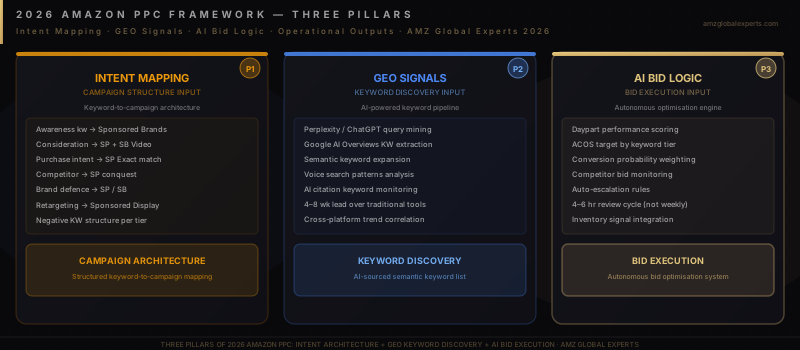
Pillar 1: Intent Mapping
Intent mapping is the process of classifying every keyword in your universe by the buyer’s likely position in the purchase decision when they type that search — and using that classification to govern bid strategy, campaign assignment, and success metrics. It is the prerequisite for every other PPC optimisation decision, because a bid strategy that does not distinguish between a buyer searching “buy ergonomic baby carrier prime delivery” and a buyer searching “how to wear baby carrier properly” will systematically over-invest in the second and under-invest in the first.
The Three-Tier Intent Classification
Metric: TACOS
Metric: CVR trend
Metric: Harvest yield
Rufus Query Classification: The New Intent Signal Layer
Amazon’s Rufus AI assistant — embedded in the search experience since late 2024 — has introduced a new class of buyer intent signal that most PPC managers are not yet capturing. When a buyer asks Rufus “what baby carrier is safest for a 2-month-old with reflux,” they are expressing extraordinarily specific, high-purchase-intent demand. The query language they use with Rufus is frequently different from the keyword language they use in a standard Amazon search, because they are interacting with a conversational interface rather than a keyword search box. Amazon’s Search Query Performance report now surfaces Rufus-origin queries separately from standard search queries for sellers who know where to look — and these queries are consistently among the highest-converting terms in the account, because the specificity of a Rufus question indicates a buyer who is very close to purchase.
Classifying Rufus queries by intent tier and creating Exact match campaigns targeting the highest-frequency, highest-converting Rufus search terms is one of the highest-leverage PPC moves available in 2026. It is also one of the least-competed: most agencies running Amazon PPC have not yet built Rufus query mining into their workflow.
Intent mapping in practice: A brand with a $20,000/month PPC budget and a flat keyword list will typically have 50–60% of spend on Tier 3 keywords generating sub-2% conversion rates. Redistributing that spend toward Tier 1 and high-converting Tier 2 keywords — without changing total budget — consistently produces 25–40% TACOS improvement within 60 days, because the same dollars are now buying clicks from buyers who are ready to purchase rather than buyers who are browsing the category.
Pillar 2: GEO Signals in PPC Keyword Strategy
GEO signals — search query patterns from AI platforms including ChatGPT, Perplexity, and Google AI Overviews — function as a leading indicator for Amazon keyword demand. The mechanism is reliable: when a specific question about your product category begins appearing frequently in AI search interactions, it signals that buyers are forming intent around that exact framing. Because AI search queries typically precede meaningful Amazon keyword volume by 4–8 weeks, monitoring GEO signals gives you a structural first-mover advantage in keyword targeting: you can add high-intent long-tail terms to your PPC campaigns before they reach detectable volume in keyword research tools, capturing early impression share at low CPC while competitors are still unaware of the opportunity.
The GEO-to-PPC Pipeline
The pipeline has four stages. Stage 1 — AI query monitoring: systematically sampling ChatGPT and Perplexity for the 20–30 most common question patterns buyers ask about your product category. This can be done manually on a bi-weekly basis (15–20 minutes per session) or automated through the AMZ Global Experts GEOPulse™ monitoring system. Stage 2 — intent classification: applying the three-tier intent framework to the extracted AI queries. Not all AI search questions are transactional — many are informational. Filter for the queries that indicate a buyer close to a purchase decision. Stage 3 — Amazon volume check: run the filtered queries through Helium 10 Magnet or DataDive. If current search volume is low (under 500 monthly searches) but the AI query frequency is high, you are looking at an emerging keyword 4–8 weeks before it peaks — exactly where you want to be. Stage 4 — PPC campaign deployment: add the emerging keyword as a Broad match target in a dedicated GEO Harvest campaign, with a low initial bid. When organic volume climbs to 1,000+ monthly searches, graduate the keyword to your Tier 1 Exact Ranking campaign at full bid.
GEO Signals That Preceded Amazon Volume Spikes in 2025–2026
Three documented patterns from ChannelBridge™ data across client accounts illustrate how GEO signals work as leading indicators. In Q3 2025, the AI search phrase “baby carrier that works with hip dysplasia” appeared with high frequency in Perplexity queries across the baby category for 6 weeks before reaching 800+ monthly searches on Amazon — brands with GEO monitoring had Exact match campaigns live and ranking organically by the time volume peaked. In Q4 2025, “protein powder without artificial sweeteners that doesn’t taste chalky” followed a 5-week GEO-to-Amazon path in the supplements category. In Q1 2026, “standing desk that fits in a small apartment” showed a 7-week GEO lead time in the home office category. In every case, early PPC entrants captured organic ranking on the emerging keyword before it became competitive — and held that ranking with lower ongoing bid requirements than late entrants.
The GEO early-entry advantage: Winning organic position on a keyword during its low-volume early phase requires significantly lower bid investment than entering after it peaks, because CPC is set by competing bids — and there are no competing bids when you are the only brand that has found the keyword yet. A keyword entered at 200 monthly searches at $0.80 CPC that grows to 3,000 monthly searches is often rankable organically by the time volume peaks — at zero ongoing PPC cost.
Pillar 3: AI-Driven Bid Logic
Manual bid management is a weekly snapshot process operating in a daily-rate environment. The four bid logic rules that form the core of an AI-driven bid system respond to conditions that do not wait for a weekly review — listing CVR shifts, inventory position changes, competitor pricing moves, and intraday conversion rate patterns. Applying these rules through an automated system — or through disciplined daily rule-based management in Amazon’s own campaign manager — consistently outperforms manual management on both TACOS and impression share efficiency.
The Four AI Bid Logic Rules
| Signal | Condition | Bid Action | Rationale |
|---|---|---|---|
| Listing CVR | CVR drops >15% below 14-day average | ↓ Reduce bids 25–40% | Buying clicks into a listing with degraded conversion efficiency is accelerating loss. Fix listing before restoring bids. |
| Listing CVR | CVR improves >10% above 14-day average post-optimisation | ↑ Raise bids 15–20% | Higher CVR means each click is more profitable. Increase impression share while the listing is converting well. |
| Inventory Cover | FBA inventory falls below 14-day cover | ↓ Reduce bids 40–60% | Winning ad clicks that cannot be fulfilled at Prime speed generates negative reviews and suppressed ranking. Throttle demand before stockout. |
| Inventory Cover | Inventory restocked above 30-day cover | ↑ Restore bids to target level | Resume full bid aggressiveness once fulfilment capacity supports the demand level. |
| Time-of-Day | Hourly conversion rate >25% above daily average (from Order Report) | ↑ Raise bids 15–25% | Peak conversion windows should receive maximum impression share. Buying peak-window clicks at 15% higher bids is almost always cost-efficient. |
| Time-of-Day | Hourly conversion rate >30% below daily average | ↓ Reduce bids 20–30% | Trough-window clicks cost the same but convert at a fraction of the rate. Redirect budget toward peak windows. |
| Competitor Price | Your price becomes >10% cheaper than top 3 competitors | ↑ Raise bids 10–15% | A price advantage increases CVR on every click. Higher bids are justified when each click converts at a higher rate. |
| Impression Share | Top-of-search impression share on Tier 1 keywords falls below 60% | ↑ Raise bids 10% weekly until target met | Top-of-search position generates 3–5× higher CVR than other-on-page placement for high-intent searches. Defend this real estate. |
Amazon Dynamic Bidding: Up and Down vs. Down Only
Amazon’s built-in dynamic bidding offers two modes relevant to the AI bid logic framework. “Dynamic bids — down only” reduces bids in real time when Amazon predicts a click is less likely to convert, but never raises them. This mode is appropriate for Harvesting and Tier 3 campaigns where waste prevention is the priority. “Dynamic bids — up and down” raises bids by up to 100% for placements Amazon predicts will convert, and lowers them for placements likely to waste spend. This mode, combined with the four manual bid logic rules above, creates a layered AI bid system: Amazon’s own algorithm handles sub-hourly micro-adjustments, while the four rules handle the macro signals (CVR state, inventory, time-of-day peaks) that Amazon’s algorithm cannot directly observe. Use “up and down” on Tier 1 Ranking campaigns where conversion quality is proven; use “down only” on Harvesting campaigns where you are testing new keywords and want waste protection.
Campaign Architecture: The 4-Campaign Structure
The intent-tiered 4-campaign structure is the operational framework that connects intent mapping to bid logic within a manageable account structure. Each campaign has a defined purpose, match type policy, bid strategy, and success metric. Running all four campaigns simultaneously gives every tier of buyer intent an appropriate bid strategy while keeping account structure simple enough to audit and optimise efficiently.
- 10–20 highest-purchase-intent Exact match keywords
- Aggressive bids targeting top-of-search position
- Dynamic bidding: Up and Down enabled
- Measure by TACOS and organic rank movement
- Weekly: defend impression share >60% on all terms
- Broad and Phrase match on full keyword list
- Lower bids — prioritise volume over position
- Dynamic bidding: Down Only
- Weekly: mine Search Term Report for converters
- Graduate converting terms to Ranking Campaign
- All brand name, product name, and ASIN variants
- Lowest bids needed to own top-of-search position
- Prevents competitors from stealing branded searches
- Measure by impression share (target: >90%)
- Review monthly — add new brand variants as they appear
- Top 10–20 competitor ASINs in Sponsored Products
- Medium bids — measure conquest CVR
- Target competitors with higher price or weaker reviews
- Measure by conquest conversion rate and CAC vs. Tier 1
- Pause ASINs with <1% conquest CVR after 200 clicks
The Weekly PPC Audit Protocol
The 4-campaign structure and AI bid logic rules require a weekly audit discipline to function correctly. The audit identifies waste to eliminate, winners to scale, and bid logic triggers to apply. A rigorous weekly audit takes 45–60 minutes with the right process — or under 10 minutes using the AMZ Global Experts PPC Audit Tool, which analyses your Amazon Advertising CSV exports and surfaces waste keywords, winner scaling candidates, and a prioritised 7-day action plan automatically.
Automate Steps 1–3 with the Free PPC Audit Tool
Upload your Amazon Advertising CSV — get a waste keyword list, winner scaling plan, budget reallocation, and 7-day action plan in under 60 seconds. All processing runs in-browser. Your data never leaves your device.
Measuring What Matters: TACOS, Organic Rank, and the Compounding Feedback Loop
The ultimate measure of PPC strategy quality in 2026 is not ACoS. It is not even TACOS in isolation. It is the relationship between TACOS trend and organic ranking movement — specifically, whether your PPC spend is producing declining TACOS over time as organic ranking improves and organic revenue grows. A PPC strategy that is working as designed shows a characteristic pattern: TACOS is relatively high (15–25%) in months 1–3 as ranking is built through paid impression investment; TACOS begins declining in months 4–6 as organic ranking on Tier 1 keywords generates organic conversions that reduce the percentage of total revenue attributable to ad spend; by months 7–12, TACOS stabilises at a structurally lower rate (8–14% for most categories) because organic traffic now handles a meaningful share of conversion volume that the brand was previously paying to buy through ads.
This compounding feedback loop — PPC investment → organic ranking improvement → organic revenue growth → declining TACOS → available budget for next keyword tier → cycle repeats — is the mechanism that separates operators running PPC as a compound growth engine from operators running it as a pure acquisition cost. The difference is entirely in measurement: if you only see ACoS, you will stop investing in the ranking phase because ACoS looks bad. If you see TACOS alongside organic rank position, you will see the compounding return building and hold your investment through the phase where short-term metrics look worst but long-term leverage is highest.
The TACOS benchmark ranges by strategy: Launch phase (months 1–3): 20–35% TACOS is expected and healthy if organic ranking is moving. Growth phase (months 4–9): 12–22% TACOS as organic revenue share increases. Mature phase (months 10+): 7–14% TACOS for well-ranked brands where organic handles 50%+ of category keyword traffic. A brand still running 25%+ TACOS in month 12 is either in a highly competitive category with minimal organic traction, or has a PPC strategy that is not converting paid impressions into organic ranking improvement.
Frequently Asked Questions
ACoS (Advertising Cost of Sales) measures ad spend as a percentage of revenue generated directly by ads — it is blind to the organic revenue that PPC ranking investment generates. TACOS (Total Advertising Cost of Sales) measures ad spend as a percentage of total brand revenue including organic. TACOS is the correct north-star metric because PPC spend compounds: it converts paid clicks and simultaneously improves organic keyword ranking that generates organic revenue ACoS cannot see. A brand with 28% ACoS but 9% TACOS is using PPC as a ranking engine. A brand with 14% ACoS but 22% TACOS is running spend that is not generating organic leverage — every sale costs nearly the same whether paid or organic.
GEO signals are search query patterns from AI platforms — ChatGPT, Perplexity, Google AI Overviews — that indicate emerging buyer intent before those queries reach meaningful Amazon keyword volume. Because AI search queries typically precede Amazon keyword volume spikes by 4–8 weeks, monitoring GEO signals lets you add high-intent long-tail keywords to your PPC campaigns before competitors notice them in keyword tools — capturing early position at low CPC while volume is building. The GEO-to-PPC pipeline: monitor AI query patterns for your category → classify by purchase intent → check Amazon volume (if low, you are early) → add as Broad match in Harvesting Campaign → graduate to Ranking Campaign when volume peaks.
The 4-campaign architecture: (1) Ranking Campaign — Exact match on 10–20 highest-purchase-intent Tier 1 keywords; aggressive bids; 50% of budget; measure by TACOS and organic rank. (2) Harvesting Campaign — Broad and Phrase match on full keyword universe; lower bids; 25% of budget; weekly mine for converting terms to graduate to Ranking. (3) Brand Defence — Exact match on all brand name variants; lowest effective bids; 10% of budget; target >90% impression share. (4) Competitor Targeting — Sponsored Products on top 10–20 competitor ASINs; medium bids; 15% of budget; pause ASINs with <1% conquest CVR after 200 clicks.
AI-driven bid logic governs bid adjustments via real-time data signals rather than weekly manual reviews. Four core rules: (1) Listing CVR drop — reduce bids 25–40% when CVR falls >15% below 14-day average; restore after listing fix is deployed. (2) Inventory suppression — reduce bids 40–60% when FBA cover falls below 14 days; restore when restocked above 30 days. (3) Time-of-day multipliers — raise bids 15–25% during peak conversion hours, reduce 20–30% during trough windows, based on hourly Order Report data. (4) Impression share defence — raise bids 10% weekly on any Tier 1 keyword falling below 60% top-of-search impression share.
Seven-step weekly protocol: (1) Pull Search Term Report (past 7 days). (2) Negative waste: keywords with 8+ clicks, zero purchases, ACoS above break-even — add as Negative Exact. (3) Graduate winners: 3+ purchases at ACoS below target — move to Ranking Campaign Exact match with 15–20% higher bid. (4) Check Ranking Campaign impression share — below 60%: raise bid 10%; below 40%: raise 20%. (5) Calculate TACOS week-over-week — rising TACOS on flat revenue: shift 10% budget from Harvesting to Ranking. (6) Apply inventory bid logic rule. (7) Mine GEO signals for 10 minutes — log new high-intent AI queries as Harvesting Campaign broad match targets. Use the free PPC Audit Tool to automate steps 1–3 from your Amazon Advertising CSV.