
The brands pulling away from their categories in 2026 are not doing more. They are doing less — but in a system designed so that every action they take simultaneously advances their position on five platforms at once. A single TikTok creator posting about their product is also driving branded search on Amazon, generating social proof that reduces Shopify bounce rate, producing UGC that improves Amazon listing CVR, and building the content layer that AI search engines cite when buyers ask for category recommendations. One action, five compounding outcomes. That is the flywheel principle applied to omnichannel commerce.
The brands still managing channels in isolation — separate Amazon team, separate Meta team, separate TikTok strategy, separate Shopify roadmap — are spending more to achieve less, because they are capturing the first-order effect of each action while leaving the second and third-order effects on the table. A TikTok campaign that drives TikTok GMV but does not connect to Amazon branded search measurement, Shopify email capture, or AI search citability content is operating at roughly 20% of its system value. The remaining 80% is the flywheel effect that only activates when the nodes are connected.
Why Platform-by-Platform Thinking Is a Growth Ceiling
The most common failure mode in multi-channel ecommerce is not poor channel execution — it is excellent channel execution in isolation. A brand can have a genuinely great Amazon PPC team, a highly capable TikTok content operation, a well-built Shopify store, and a solid email programme, and still find itself hitting a growth plateau that more spend on any individual channel cannot break through. The reason is attribution blindness: each team measures the performance of their channel against its own metrics and optimises within that frame. The Amazon team sees TACOS and ROAS. The TikTok team sees GMV and creator CPV. The email team sees open rate and revenue per send. Nobody measures the force that connects them.
What that attribution blindness conceals is that each channel is both a destination and a catalyst — and the catalyst function is almost always more valuable than the destination function over a 12-month horizon. A TikTok creator campaign that generates $80,000 in direct TikTok GMV and a $220,000 spike in Amazon branded search revenue should be evaluated on its $300,000 combined value, not its $80,000 direct value. Brands measuring only direct channel attribution are systematically under-investing in their highest-leverage activities and over-investing in whatever channel looks good in last-click reporting.
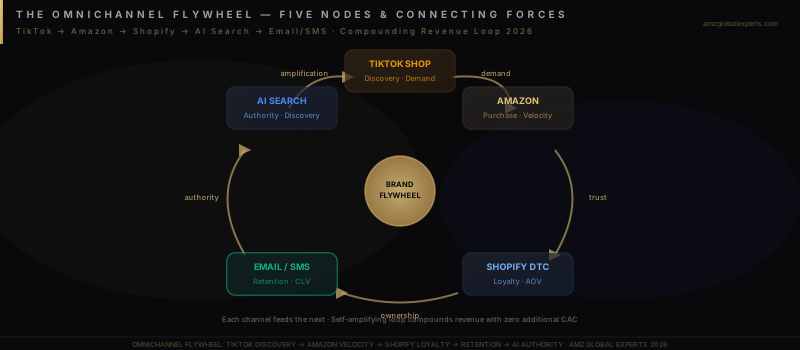
The Five Nodes of the Omnichannel Flywheel
Each node in the Omnichannel Flywheel has a primary function — what it does best as a standalone channel — and a flywheel function, which is the specific output it generates that accelerates the other nodes. Understanding the distinction between these two functions is the prerequisite for building a connected system rather than a collection of high-performing individual channels.
The Connecting Forces: How Each Node Feeds the Others
The flywheel’s compound growth property emerges from its connecting forces — the specific mechanisms through which each node’s activity generates inputs for other nodes. There are ten primary connecting forces in the Omnichannel Flywheel. Each is directional (from one node to another) and measurable (through ChannelBridge™ attribution). The brands building the most durable growth moats in 2026 are the ones who have identified which connecting forces are most active in their specific category and are systematically investing in accelerating those connections.
| From | To | Connecting Force | |
|---|---|---|---|
| TikTok Shop | → | Amazon | Viral product moments drive branded search spikes; creator external traffic boosts A10 organic ranking |
| TikTok Shop | → | AI Search | Creator video content and product page copy populate the indexed web layer that AI engines cite for recommendations |
| Amazon | → | Shopify | Post-purchase inserts, QR codes, and exclusive offers migrate Amazon buyers to the owned Shopify customer base |
| Amazon | → | AI Search | Review volume and listing content authority improve brand entity recognition in AI model training data |
| Shopify | → | TikTok Shop | Owned customer base recruited as UGC creators through post-purchase email sequences; creator content feeds demand generation |
| Shopify | → | Email / SMS | First-party customer data (purchase history, browsing behaviour) feeds segmented retention and reactivation sequences |
| AI Search | → | Amazon | AI recommendation citations drive branded search on Amazon; discovery traffic hits product listings directly |
| AI Search | → | Shopify | AI-cited blog content and product pages drive direct Shopify traffic from buyers who received brand recommendations |
| Email / SMS | → | Amazon | Replenishment sequences drive Amazon repeat purchase velocity; review request flows improve listing CVR and ranking |
| Email / SMS | → | TikTok Shop | Reactivation sequences recruit dormant customers as TikTok creators and affiliate partners; UGC incentive flows generate new creator content |
Node Deep-Dive: TikTok Shop as the Demand Engine
TikTok Shop reached $35 billion in GMV in 2025, with projections pointing toward $70–90 billion by the end of 2026. But the raw GMV number dramatically understates TikTok’s value as a flywheel node, because it measures only the direct conversion effect — the purchase made on TikTok itself. The indirect flywheel effect — the Amazon branded search volume driven by TikTok visibility — is typically 2.1–3.8× the direct GMV for brands with established Amazon presence and strong product-market fit in categories with active TikTok communities.
The mechanism is straightforward: a buyer who sees a product perform in a creator’s TikTok video and does not purchase on TikTok frequently searches for that product on Amazon within 48–72 hours — using the brand name or the specific product descriptor from the creator’s copy. That branded search on Amazon costs the brand zero in PPC (it is organic), converts at 3–5× the rate of generic keyword traffic (because the buyer already has purchase intent validated by social proof), and generates A10 ranking improvement through conversion velocity. A TikTok strategy that is not connected to Amazon branded search monitoring is missing most of its own value.
The TikTok-to-Amazon multiplier: Internal ChannelBridge™ attribution data across brands with active TikTok creator programmes shows that for every $1 of direct TikTok Shop GMV, brands with connected flywheel measurement capture an additional $1.40–$2.20 in attributable Amazon revenue from branded search spikes occurring within the subsequent 72-hour window. This connecting force is invisible to brands measuring TikTok only on direct platform GMV.
Node Deep-Dive: AI Search as the Discovery Multiplier
AI search is the most underactivated node in the Omnichannel Flywheel for most ecommerce brands in mid-2026, and therefore the highest-opportunity connecting force available for brands ready to build ahead of their competitors. When a buyer asks ChatGPT “what’s the best ergonomic baby carrier for plus-size moms,” the AI system returns a recommendation set from its training data and web browsing capability. If your brand appears in that recommendation — cited by name, with specific features referenced — the buyer’s next action is a branded search on Amazon or Google. That branded search is warm demand: the buyer already has a recommendation and is seeking to validate and purchase, not to research. Branded search conversion rates on Amazon average 3–5× the conversion rate of generic category searches.
The GEO (Generative Engine Optimization) framework that governs AI search citability is distinct from traditional SEO but complementary to it. The primary signals that cause AI systems to cite a brand are: authoritative content that directly answers specific questions buyers ask in the product category; structured schema markup that makes brand and product entity data machine-readable; review volume and social proof infrastructure that AI systems interpret as market validation; and consistent brand mentions across high-authority platforms (Reddit, expert blogs, industry publications) that establish entity recognition in AI training data. Brands that are not yet investing in GEO infrastructure are not just missing an emerging channel — they are actively allowing competitors to capture branded recommendation real estate that will be harder to displace once AI citation patterns are established.
Node Deep-Dive: The Amazon-to-Shopify Migration Engine
Amazon’s structural limitation — that every buyer belongs to Amazon rather than to your brand — is the single most important reason Shopify is a non-negotiable node in the Omnichannel Flywheel. The Amazon buyer who purchases from you three times is, from Amazon’s perspective, a three-time Amazon buyer. From your brand’s perspective, they are an anonymous transaction record in a marketplace you do not control. The migration from anonymous Amazon buyer to owned Shopify customer is the highest-leverage move available to a brand operating on the flywheel architecture, and it happens through three primary mechanisms.
The first and most effective is the post-purchase insert: a physical card included in FBA shipment packaging that offers a genuine value exchange — an extended warranty, a product guide, an exclusive discount, or a community membership — in return for visiting a Shopify URL and registering. Insert-to-Shopify conversion rates average 8–14% for well-designed offers in most categories. On a brand doing 300 Amazon units per day, that is 25–42 new owned customers added to the Shopify email list daily — without any additional acquisition cost. The second mechanism is the review-to-relationship sequence: the post-purchase review request email that also invites the buyer to the brand’s community, newsletter, or loyalty programme. The third is the QR code on secondary product packaging — an unboxing-moment redirect to a Shopify registration page with a mobile-optimised landing experience. Each owned customer acquired through these mechanisms enters the email/SMS retention node and begins the LTV compounding sequence that eventually generates TikTok creator recruitment and AI search authority contributions through their reviews and social mentions.
The ChannelBridge™ Attribution Model
Building an Omnichannel Flywheel requires a measurement architecture that can see the connecting forces — not just the nodes. Standard last-click attribution assigned to individual platforms systematically misattributes the value of the flywheel’s cross-channel effects, producing investment decisions that starve the highest-leverage connecting forces and over-invest in the channels that win attribution races rather than the channels that generate compounding system momentum.
ChannelBridge™ is AMZ Global Experts’ cross-platform attribution model built specifically to measure flywheel connecting forces. It operates on four attribution layers. The first is time-window branded search correlation: measuring Amazon branded search volume changes in the 72-hour window following TikTok content publication or paid media spend, attributing the associated Amazon revenue to the originating platform using a decaying correlation model. The second is customer journey mapping: connecting Shopify customer registration source data to prior Amazon purchase history and TikTok ad exposure records, building a complete multi-touch journey that assigns fractional credit to each node. The third is AI citation tracking: monitoring brand mentions and citation appearances across major AI platforms using automated query sampling, correlating citation spikes with downstream branded search volume changes. The fourth is cohort LTV modelling: comparing the 6-month and 12-month LTV of customers acquired through each node and each connecting force, enabling investment reallocation toward the acquisition paths that produce the highest long-run value rather than the lowest initial CAC.
What ChannelBridge™ typically reveals: In the majority of brand engagements, the TikTok-to-Amazon connecting force and the Amazon-to-Shopify migration force are delivering 40–60% of total brand revenue when fully attributed — but are receiving less than 15% of marketing investment attention because they are invisible in standard last-click reporting. The reallocation of 20–30% of marketing budget toward activating these connecting forces is consistently the highest-ROI intervention available.
The 90-Day Flywheel Spin-Up Sequence
An Omnichannel Flywheel does not activate instantaneously — it requires a sequenced build that respects the dependency relationships between nodes. The 90-day sequence that AMZ Global Experts uses to bring a brand from fragmented channel execution to a functioning flywheel is structured in three 30-day phases.
The compound growth signal to watch: The clearest indicator that a flywheel is functioning is a declining blended CAC over time despite flat or increasing total revenue. In a fragmented channel model, CAC is sticky — it tracks paid media CPMs and competitive bid pressure. In a flywheel model, each rotation increases organic branded search volume, owned customer base size, and AI citation frequency — all of which reduce paid acquisition dependency. A declining CAC curve in months 3–9 is the flywheel working.
Frequently Asked Questions
The Omnichannel Flywheel is a growth architecture in which five platform nodes — TikTok Shop (demand generation), Amazon (trust and conversion), Shopify (ownership and LTV), AI Search (discovery), and Email/SMS (retention) — are connected so that activity on each node accelerates momentum on every other. Unlike multi-channel execution where each platform is managed in isolation, a flywheel system routes the outputs of one platform as inputs for the next: TikTok drives Amazon branded search; Amazon buyers migrate to Shopify ownership; Shopify customers become TikTok creators; AI search citations drive branded search across all nodes; email keeps the flywheel spinning between demand spikes. Each rotation compounds the next.
TikTok Shop activity affects Amazon rankings through two compounding mechanisms. First, viral product moments on TikTok drive branded search volume on Amazon — buyers who discover a product on TikTok frequently search for it on Amazon within 48–72 hours to read reviews, compare pricing, and leverage Prime delivery. This branded search spike is interpreted by Amazon’s A10 algorithm as a demand quality signal, improving organic keyword rankings. Second, external traffic from TikTok links hitting Amazon product listings directly is one of the most weighted signals in the A10 external traffic scoring model — improving organic position on core category keywords independent of PPC spend.
Amazon is structurally incapable of two of the five flywheel functions: customer ownership and LTV compounding. Every Amazon buyer belongs to Amazon, not to your brand. You cannot email them, retarget them, recruit them as UGC creators, or build a direct relationship. Shopify is the ownership layer — the destination where Amazon buyers are converted to owned customers through post-purchase inserts and email capture. An owned Shopify customer has 3.2× the lifetime value of a marketplace-only buyer, can be recruited as a TikTok creator, and can be reactivated at near-zero marginal cost. Removing Shopify from the flywheel permanently caps LTV and makes every repeat purchase dependent on paid acquisition.
AI search — ChatGPT, Perplexity, Google AI Overviews, Gemini — functions as a discovery multiplier in the flywheel. When an AI system cites your brand in response to a product category query, it drives branded search on Amazon and Shopify from buyers who already have a recommendation and are seeking to validate and purchase. Branded search conversion rates are 3–5× higher than generic category searches. Brands optimised for GEO (Generative Engine Optimization) capture a discovery channel most competitors are not yet targeting, gaining recommendation real estate that becomes harder to displace as AI citation patterns are established.
A functioning flywheel with all five nodes active and connected typically requires 90 days from infrastructure build to measurable cross-channel momentum. Days 1–30: data unification and node activation (all channels connected to ChannelBridge™ attribution). Days 31–60: connecting force deployment (Amazon-to-Shopify migration, TikTok creator programme, GEO content launch). Days 61–90: compound momentum measurement and investment reallocation toward the highest-performing connecting forces. First measurable flywheel effects — TikTok-driven Amazon branded search spikes, Shopify customer migration rate, AI citation traffic — are typically visible within weeks 6–10.