Most Shopify store owners encounter the same decision point at some stage of growth: the numbers plateau, and someone recommends an audit. The problem is that "audit" covers two distinct, often misunderstood services — a Shopify SEO Audit that analyses your organic search visibility, and a Shopify Agency Audit that diagnoses your full revenue system. Choosing the wrong one costs time, money, and months of compounding opportunity. Choosing the right one can add 20–40% incremental revenue from the same traffic.
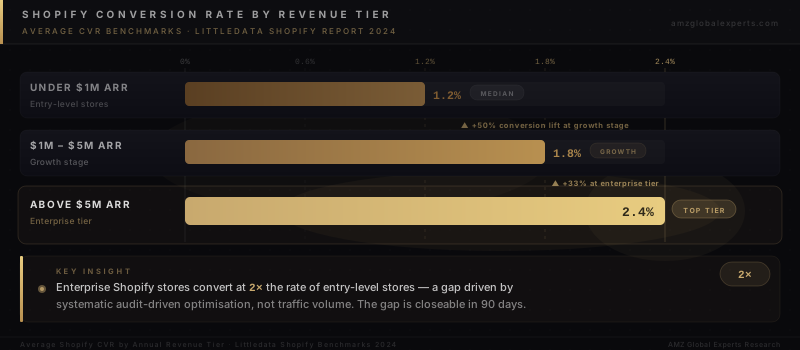
Shopify powers more than 4.4 million online stores globally (Shopify Inc., 2024), with the platform processing $236 billion in merchant GMV in 2023 alone. The average Shopify store converts at 1.2–2.4% (Littledata, 2024) — meaning that for every 100 visitors, 97–99 leave without buying. An audit of the right type is the fastest mechanism for understanding exactly why, and what to fix first.
The Two Audit Types Defined
The confusion between these two audit types is understandable — both involve analysis, both produce recommendations, and both are positioned by agencies as growth tools. The structural difference is scope: an SEO audit is focused on one acquisition channel; an agency audit covers every revenue system.
What Is a Shopify SEO Audit?
A Shopify SEO Audit is a structured evaluation of your store's organic search visibility across five dimensions: on-page elements (titles, meta descriptions, H1 structure, heading hierarchy), technical infrastructure (crawlability, indexability, Core Web Vitals, canonical tags, robots.txt), content gaps (topics and keywords your category owns that your store does not), structured data (JSON-LD schema markup for products, articles, FAQs), and increasingly, AI search readiness — whether your store is optimised for Google AI Overviews, Perplexity, and ChatGPT web search.
A well-executed SEO audit produces a prioritised action plan. Not a 200-page technical report filed and forgotten, but a sequenced list of fixes ranked by impact-to-effort ratio: what to implement in the first 30 days, what requires 60–90 days, and what compounds over 180 days. The output is traffic: sustainable, compounding, zero-CAC organic visitors arriving with specific purchase intent.
What Is a Shopify Agency Audit?
A Shopify Agency Audit is a full revenue system diagnostic. It extends well beyond organic search to evaluate every lever that drives and retains revenue: paid media efficiency (Meta, Google, TikTok), email and SMS retention architecture, product page conversion architecture, checkout friction analysis, average order value optimisation, pricing strategy, creative performance, brand positioning, and operational infrastructure (fulfilment speed, return rates, customer service resolution time).
Where an SEO audit asks "why is our organic traffic underperforming?", an agency audit asks "why is our store's total revenue below its potential?" — and maps every constraint across the full acquisition and retention funnel. The output is a prioritised growth roadmap that identifies which levers, across which channels, produce the highest compounding return over 90 days.
What a Shopify SEO Audit Covers: The Full Checklist
A professional Shopify SEO Audit systematically evaluates the following dimensions. Each category drives measurable organic traffic when fixed — and measurable traffic loss when neglected.
On-Page SEO Signals
Every product page, collection page, and blog post on your Shopify store sends signals to Google about topical relevance and search intent match. A complete on-page audit evaluates: title tags (60–65 character sweet spot, primary keyword in first three words), meta descriptions (150–160 characters with CTA), H1 uniqueness and keyword alignment, heading hierarchy (H2/H3 structure for content depth signals), and image alt text coverage. Shopify's default theme architecture frequently generates duplicate title tags across collection and product pages — a specific failure mode that causes canonical signal dilution and suppresses rankings on the store's highest-value commercial pages.
Technical SEO Infrastructure
Technical SEO failures are invisible to the store owner but permanently visible to Google's crawl budget. The most common Shopify technical failures: duplicate content from URL parameter variants (/collections/all, /collections/all?sort_by=best-selling generating separate indexable pages), pagination canonical errors, missing or malformed XML sitemaps, slow server response times from unoptimised third-party app scripts, and hreflang errors on stores serving multiple geographic markets. Google's John Mueller has confirmed that uncrawlable pages receive no indexing consideration regardless of content quality — technical barriers erase all investment in on-page work.
Core Web Vitals and Performance
Google uses Core Web Vitals as a direct ranking signal. The average Shopify store running 10–15 third-party apps scores Largest Contentful Paint (LCP) of 3.2–4.8 seconds on mobile (Cloudflare Radar, 2024) — against Google's Good threshold of under 2.5 seconds. Each 1-second improvement in LCP correlates with an 8–12% conversion rate improvement (Google Web Fundamentals, 2024). A Shopify SEO audit identifies the specific scripts, render-blocking resources, and image optimisation failures causing performance degradation — and sequences the fixes by impact.
Content Gap Analysis
Content gap analysis identifies the informational and commercial keywords that consumers in your category are actively searching that your store does not yet rank for. Using tools such as Ahrefs and SEMrush combined with Shopify's native blog architecture, a content gap audit produces a prioritised list of blog topics and collection page expansions that, when created with appropriate depth and authority, compound organic traffic over 90–180 days. For stores above $1M annual revenue, this is typically the highest-ROI element of the SEO audit — organic traffic acquired at zero marginal CAC.
AI Search Readiness (GEO)
Google AI Overviews, Perplexity, ChatGPT web search, and Gemini now answer millions of commercial queries daily. The stores cited in AI-generated answers receive zero-click traffic uplift and brand authority signals that compound over time. A modern Shopify SEO audit evaluates AI readiness across four signals: structured data coverage (Product, Organization, FAQPage, Article JSON-LD schemas), llms.txt compliance (the emerging AI indexing standard analogous to robots.txt), entity recognition signals in your content, and whether your AI bot access policy in robots.txt permits or blocks GPTBot, ClaudeBot, and PerplexityBot.
What a Shopify Agency Audit Covers: The Full System
A Shopify Agency Audit evaluates the six revenue systems that collectively determine a store's total economic output. Missing any one of these creates a structural leak that SEO optimisation alone cannot compensate for.
Paid Media Efficiency Audit
The paid media audit evaluates blended ROAS, campaign architecture, audience targeting logic, creative performance trends, and attribution methodology across Meta Ads, Google Shopping, and TikTok Ads. The single most common finding: brands operating with channel-reported ROAS rather than blended MER (Marketing Efficiency Ratio = Total Revenue ÷ Total Ad Spend), which makes underperforming channels appear profitable through attribution overlap. A full audit typically identifies 15–30% efficiency improvements through audience deduplication, bid strategy correction, and creative rotation systems.
Email and SMS Retention Architecture
Email and SMS are the highest-ROI channels available to Shopify stores — $42 return per $1 invested in email marketing (Litmus Email Marketing ROI Report, 2023) — yet the majority of Shopify stores leave 40–60% of retention revenue on the table through incomplete flow architecture. An agency audit evaluates: abandoned cart flow completion and timing, post-purchase sequence depth, win-back campaign performance, SMS opt-in rate and list health, and segmentation logic. Brands with five or fewer email flows are missing the retention infrastructure that separates 15% repurchase rates from 40% repurchase rates.
Conversion Rate and Checkout Architecture
Baymard Institute's 2025 analysis links 70.19% cart abandonment to 26 mechanical and psychological failure patterns. An agency audit evaluates the specific patterns present in your store: unexpected shipping cost disclosure timing, mandatory account creation, insufficient trust signals at checkout, mobile UX failures (rage clicks, CLS-induced tap errors), and absence of scarcity or urgency signals. For a store generating $2M annually at a 2.1% conversion rate, moving to 2.5% through checkout architecture fixes produces $380,000 in incremental revenue from identical traffic — at zero additional acquisition cost.
Average Order Value and Upsell Architecture
AOV optimisation is the highest-leverage arithmetic lever in Shopify — a 20% AOV increase on $2M revenue produces $400,000 in incremental GMV at no change in customer count. An agency audit identifies: bundle opportunity gaps (frequently co-purchased products not presented as bundles), post-purchase upsell sequence completeness, subscription model viability by product category, and threshold-based free shipping incentive calibration. Shopify stores with AOV below category benchmarks are typically missing two or three structural upsell architecture elements, not facing a demand problem.
The Side-by-Side Comparison
| Dimension | Shopify SEO Audit | Shopify Agency Audit |
|---|---|---|
| Scope | Organic search visibility only | All revenue systems (paid, organic, email, CRO, AOV, ops) |
| Time to First Impact | 45–90 days (organic takes time to compound) | 14–30 days (paid and CRO fixes are immediate) |
| Compounding ROI Horizon | 6–18 months (organic traffic compounds indefinitely) | 3–6 months per cycle (paid ROI depends on ongoing management) |
| Typical Cost | $1,500–$8,000 (one-time) | $5,000–$20,000 (one-time audit + implementation retainer) |
| Best For | Stores with traffic but poor organic rankings | Stores with traffic but stagnant or declining total revenue growth |
| Revenue Impact (Median) | 15–35% organic traffic increase over 6 months | 20–40% total revenue increase over 90 days |
| Covers AI Search (GEO) | Yes — if audit includes modern GEO signals | Partially — depends on agency specialisation |
| Prerequisite | Working Shopify store, Google Search Console access | Full analytics access across all platforms (Meta, Google, Klaviyo) |
What Real Shopify Store Owners Are Saying
Reddit's r/shopify, r/ecommerce, and r/Entrepreneur communities generate thousands of threads annually on store growth, audits, and agency relationships. Three patterns emerge consistently from high-engagement discussions in 2025–2026:
r/shopify store owner: "We hired an agency to 'grow our store' and six months later the only thing that changed was our monthly invoice. Turns out they were just running the same ad campaigns we had before, just at a higher budget. We needed someone to actually audit what was broken before throwing more spend at it." — This reflects the most common agency misalignment: growth services delivered before diagnostic clarity. An audit-first model eliminates this failure pattern.
r/ecommerce operator: "SEO audit was the best $3,000 I've spent. Found out our collection pages had duplicate meta titles, our Core Web Vitals were below 40 on mobile, and we had zero schema markup. Fixed those three things in 45 days and organic traffic went up 28% by month three." — Technical SEO failures are typically fixable within one sprint. The compounding organic traffic benefit accumulates for years.
r/Entrepreneur Shopify brand operator: "Our problem wasn't traffic — it was that traffic wasn't converting. An agency audit found our checkout had unexpected shipping costs showing up at the last step, no guest checkout option, and our email abandonment sequence was only one email. Fixing those three things added $22,000 in monthly revenue in the first six weeks." — This is the signature pattern of a conversion audit finding: high traffic, low conversion, and structural fixes with immediate revenue impact.
The recurring pattern across r/shopify threads is that store owners who conflate audits with ongoing management retainers end up paying for growth services before understanding why their current systems underperform. The correct sequence is: audit first, implementation second, ongoing management third.
The Decision Framework: Which Audit Do You Need?
The right audit depends on two diagnostic questions. First: where is your primary constraint — traffic or conversion? Second: what is your primary revenue growth hypothesis — that you need more visitors, or that your existing visitors should spend more?
Choose a Shopify SEO Audit If:
- Your store generates fewer than 5,000 monthly organic sessions and you operate in a category with significant organic search volume
- You rank on page 2–5 for your primary product keywords and have not performed a technical SEO audit in the past 12 months
- Your blog generates less than 15% of total store traffic despite regular content publication
- You have not implemented Product, Organisation, and FAQPage JSON-LD schema markup
- Your store's Core Web Vitals show LCP above 3 seconds on mobile
- You want a sustainable, compounding acquisition channel that reduces paid media dependency over 12–18 months
Choose a Shopify Agency Audit If:
- Your store has 10,000+ monthly sessions but conversion rate below 1.5%, indicating a conversion architecture problem rather than a traffic problem
- You are investing $10,000+ per month in paid media but blended ROAS is below 2.5×
- Your email and SMS list has 5,000+ subscribers but repeat purchase rate is below 20%
- AOV has been flat for 6+ months despite catalogue expansion
- Cart abandonment rate above 75% despite adequate traffic quality
- You need executive-level diagnosis across all growth systems before committing to an agency retainer
Key Decision Rule: A Shopify SEO Audit optimises one specific acquisition channel. A Shopify Agency Audit maps the entire revenue system. Stores with fewer than 5,000 monthly sessions typically need traffic before they need conversion optimisation — start with the SEO audit. Stores above 10,000 monthly sessions with flat revenue growth almost always have a conversion or retention problem that the SEO audit will not solve.
The Cost and ROI Breakdown for 2026
Understanding the typical investment range and expected return for each audit type enables accurate ROI modelling before commissioning either service.
Shopify SEO Audit Investment and Return
Professional Shopify SEO Audits range from $1,500 (technical-only, smaller stores) to $8,000 (comprehensive with content gap analysis, GEO audit, and full AI readiness assessment). Implementation typically costs an additional $3,000–$10,000 if the agency handles fixes rather than the internal team. The return compounds: a store generating $500,000 in annual organic revenue that increases organic traffic 28% through audit-driven fixes adds $140,000 in annual organic revenue at zero additional CAC. Payback period on a $5,000 SEO audit with $10,000 implementation is typically 4–8 weeks of compounding organic growth.
Shopify Agency Audit Investment and Return
A full-scope agency audit from an experienced operator ranges from $5,000–$20,000 depending on catalogue complexity and platform breadth. Implementation retainers for an agency managing paid media, email, and conversion optimisation following the audit add $5,000–$15,000 per month. The return is more immediate: the majority of high-value agency audit findings (checkout architecture fixes, email flow completion, shipping cost transparency) produce revenue impact within 14–45 days of implementation. For a store generating $2M annually, a 20% total revenue improvement from audit-driven fixes produces $400,000 in incremental annual revenue.
How to Prepare for Either Audit: The Data Access Checklist
The quality of any audit output is directly proportional to the data quality available to the auditor. Before commissioning either type, ensure the following access is in place:
- Google Search Console — 12 months of query performance data, coverage reports, and Core Web Vitals report (required for SEO audit)
- Google Analytics 4 — Funnel exploration data, checkout completion rate by device, session source breakdown (required for both)
- Shopify Analytics — Conversion funnel, AOV trend, repeat purchase rate, top traffic sources (required for both)
- Meta Ads Manager — 90 days of campaign data at account and ad set level with attribution window settings visible (required for agency audit)
- Klaviyo or email platform — Flow performance data, list health metrics, revenue per email sent benchmarks (required for agency audit)
- Ahrefs or SEMrush access — Organic keyword rankings, domain authority, backlink profile (required for SEO audit)
How AMZ Global Experts Helps
AMZ Global Experts conducts both Shopify SEO Audits and full Shopify Agency Audits for direct-to-consumer brands and Amazon-to-Shopify expansion operators. Our audit-first model is structured on a fundamental principle: no growth recommendation without diagnostic evidence.
Our Shopify SEO Audit covers all seven dimensions — on-page signals, technical infrastructure, Core Web Vitals, content gap analysis, structured data implementation, internal link architecture, and AI search readiness (GEO signals, llms.txt, entity optimisation). Every finding is prioritised by the impact-to-effort matrix that characterises our forensic CRO framework.
Our Shopify Agency Audit evaluates the full revenue system: paid media blended ROAS and attribution architecture, email and SMS retention flow completeness, checkout abandonment forensics (matching the Reddit intelligence and CRO methodology we have published), AOV and bundle opportunity mapping, and competitive positioning analysis. The output is a 90-day execution roadmap — not a document, but a sequenced implementation plan.
For brands operating on both Amazon and Shopify, we provide integrated audits that identify the cross-channel attribution gaps and inventory coordination failures that single-platform audits miss. The full scope of this approach is outlined in our Shopify architecture enterprise guide and our ecommerce operating system migration framework.
Every audit client receives a post-delivery working session with the lead analyst — walking through each finding, answering implementation questions, and confirming the sequencing rationale. No report goes unreviewed. Every recommendation is actionable within the client's existing team structure or manageable with clearly scoped external support.
If your Shopify store has plateaued, book a strategy session. The audit type will become clear in the first fifteen minutes of diagnostic conversation. What is always clear before we begin: the gap between current performance and potential is almost never as small as it feels.
Frequently Asked Questions
A Shopify Agency Audit is a comprehensive review of every revenue-generating system in your store — paid media, email and SMS retention, conversion rate, product positioning, creative, and operational infrastructure. It is designed to identify the highest-leverage growth opportunities across the full customer acquisition and retention funnel, not just your search visibility.
A Shopify SEO Audit is a structured evaluation of your store's organic search visibility — covering on-page elements, technical SEO, Core Web Vitals, content gap analysis, structured data, and AI search readiness (GEO signals). A well-executed SEO audit produces a prioritised action plan that compounds organic traffic over 60–180 days.
A professional Shopify SEO Audit from an experienced agency ranges from $1,500–$8,000 depending on site complexity, catalogue depth, and the scope of deliverables. Comprehensive audits including content gap analysis, GEO signals, and AI readiness assessment sit at the higher end of the range. Implementation adds $3,000–$10,000 if the agency handles fixes.
Technical SEO fixes typically show measurable organic ranking improvements within 45–90 days. Content gap pages build organic traffic over 90–180 days. Core Web Vitals improvements produce conversion rate benefits within 2–3 weeks of deployment. Full compounding from a complete SEO audit typically materialises over a 6–12 month horizon.
Yes — and for stores above $500,000 in annual revenue, doing both simultaneously is the optimal approach. The SEO audit rebuilds the organic acquisition channel while the agency audit optimises conversion, retention, and paid efficiency. Brands that run both in parallel generate compounding returns: higher organic traffic converting at a higher rate through a more optimised checkout experience.